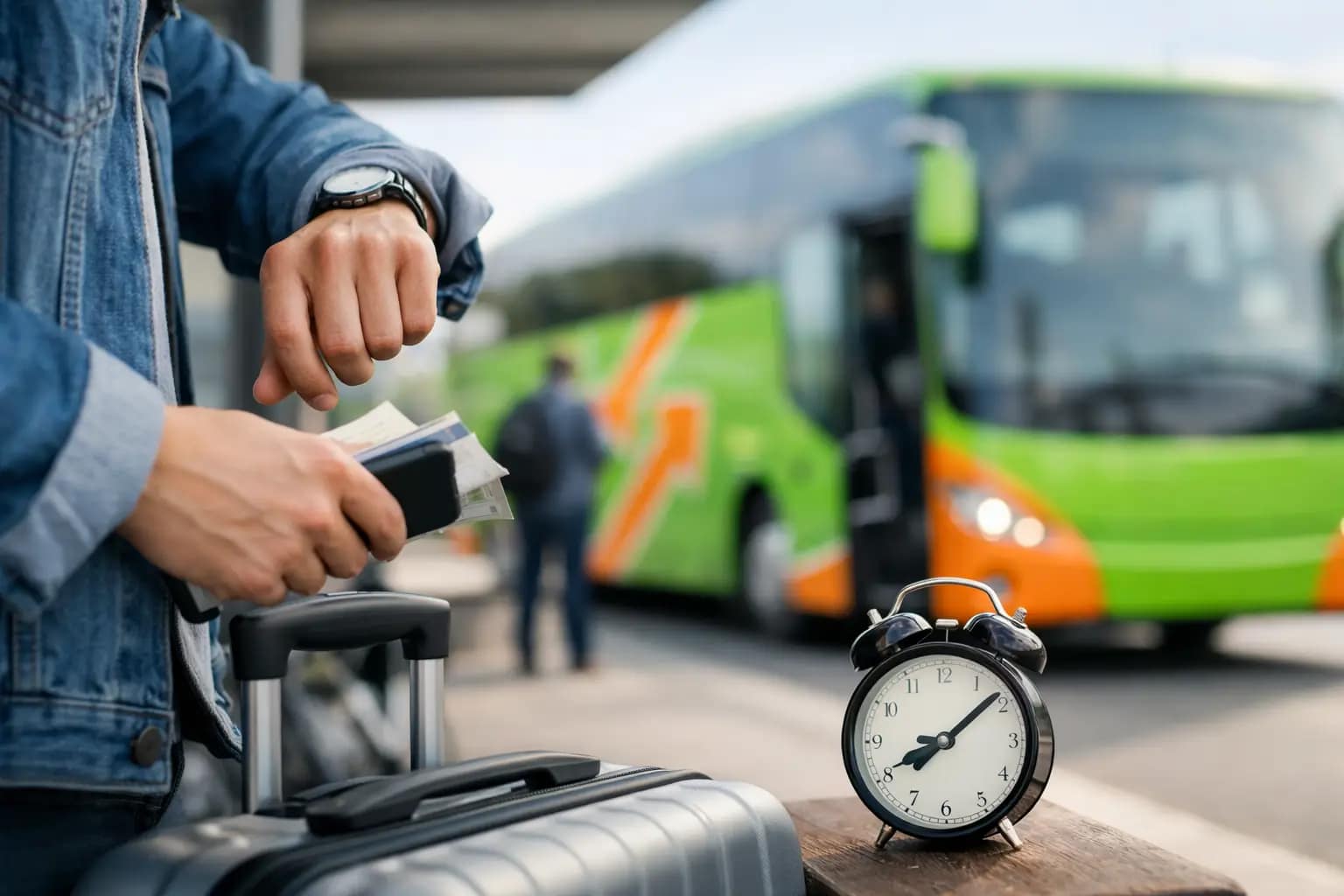
A FlixBus trip usually becomes stressful in the last 20 minutes, not during the ride itself. The real problem is getting to the stop with enough time, in the right place, with your ticket ready and no last-minute confusion. If you want to get at FlixBus stop on time and plan in advance without a risk missing it, the solution is not luck. It is a simple, realistic travel plan built around timing, location, and backup options.
Why FlixBus departures are easy to miss
Many travelers assume a bus stop works like a small station with clear signs, staff, and time to adjust if something goes wrong. In practice, many FlixBus stops are much simpler. Some are on a street, near a parking area, or outside a train station. That makes them convenient, but it also means there is less margin for error.
A missed departure usually happens for ordinary reasons. The stop is farther away than expected. Traffic is heavier than usual. The pickup area is not obvious. A traveler arrives at the general address but not the exact boarding point. Even five or ten minutes of uncertainty can be enough to miss the bus.
This is why planning ahead matters more than most people think. Good timing is not just about leaving early. It is about understanding the route to the stop, the local traffic pattern, how much luggage you have, and whether you can count on your transportation.
How to get to a FlixBus stop on time and plan ahead
Start with the exact stop, not just the city name. This sounds obvious, but it is one of the most common mistakes. A city may have more than one FlixBus stop, and the difference between them can be significant. Check the full stop name in your booking, then confirm the exact pickup point on a map before the day of travel.
Next, look at the stop as a real place, not just an address. Is it next to a train station entrance, behind a parking lot, or on a specific side of the street? If the area is unfamiliar, save a screenshot and review it in advance. On travel day, you do not want to spend time interpreting directions while carrying bags.
Then work backward from departure time. If your bus leaves at 2:00 PM, your target should not be to arrive at 2:00 PM. In most cases, arriving 15 to 20 minutes early is a safer standard. If the stop is large, busy, or unfamiliar, 25 to 30 minutes may be more reasonable. That buffer gives you time to locate the correct boarding area, organize luggage, and handle small delays without panic.
The next step is to plan the transfer to the stop with realistic timing. This is where many people underestimate the risk. A route that takes 15 minutes in ideal conditions may take 30 minutes with traffic, roadwork, weather, or hotel checkout delays. If you are traveling during peak hours, on a holiday, or in a tourist area, add extra time on purpose.
There is no single rule that fits every trip. A solo traveler leaving from a central hotel with one backpack has more flexibility than a family with children and multiple suitcases. A direct ride to the stop is usually the lowest-risk choice, especially early in the morning, late at night, or when connections are limited.
Build your timing around real conditions
A practical way to plan is to separate the trip into three parts: preparation time, transfer time, and arrival buffer. Preparation time includes checkout, loading luggage, elevator delays, and simply getting out the door. Transfer time is the ride itself. Arrival buffer is the time you want to have once you reach the stop.
For example, if your bus departs at 9:30 AM and you want to be there by 9:10 AM, do not just book a car for 8:55 AM because the route looks short. Think about how long it takes to leave your room, meet the driver, load bags, and reach the exact stop. This approach sounds basic, but it prevents rushed departures and unnecessary stress.
Morning departures deserve special attention. Many travelers assume roads are empty early in the day, but airport traffic, commuter traffic, and delivery traffic can all affect timing. Evening departures have different risks, including reduced visibility, unfamiliar pickup areas, and fewer alternatives if something changes.
Luggage changes the plan more than people expect
Travelers often focus on travel time and forget how much luggage slows every step. One small carry-on is simple. Multiple bags, sports equipment, strollers, or shopping luggage change the pace completely.
More luggage means more time to move from the hotel lobby, more attention when boarding, and less flexibility if the stop is crowded. If you are carrying several pieces, arriving earlier is not excessive. It is practical. The same applies if you are traveling with children, older passengers, or anyone who benefits from a more comfortable pace.
Common mistakes that increase the risk of missing the bus
The biggest mistake is trusting one optimistic estimate. Navigation apps are useful, but they are not a guarantee. They do not always reflect how long it takes to find the exact pickup spot, manage luggage, or deal with local congestion.
Another common issue is assuming that any nearby drop-off point is good enough. With bus departures, close is not always close enough. Being dropped on the wrong side of a station or at the wrong entrance can cost valuable minutes.
Some travelers also wait too long to arrange transportation. Last-minute decisions reduce your options and increase uncertainty. If you need to leave a hotel, apartment, business meeting, or private address at a specific time, advance planning gives you more control and fewer surprises.
When a private transfer makes the difference
If your schedule is tight, a private transfer is often the simplest way to reduce risk. This is especially true when you are in an unfamiliar area, traveling with luggage, coordinating a group, or catching a bus at an unusual hour.
A prearranged ride gives you a clear pickup time, direct service, and less dependence on local variables. That does not mean every trip requires one. If your hotel is a short walk from the stop and your schedule is flexible, walking may be perfectly reasonable. But if missing the bus would disrupt a flight, train, work appointment, or hotel check-in, reliability matters more than saving a few minutes or a small amount of money.
For travelers staying in South Tyrol or moving through Bressanone, a local operator with direct service can be especially helpful because local knowledge matters. A driver who already knows the access points, traffic patterns, and pickup logistics can reduce uncertainty in a very practical way. Services such as Taxi Brixen Bressanone James are often chosen for exactly this reason: not just transportation, but dependable timing.
A simple checklist to get at FlixBus stop on time
The safest travel plans are usually the simplest ones. Confirm your exact stop the day before, prepare your ticket and luggage early, and set a target arrival time that gives you breathing room. Then choose transportation based on actual conditions, not best-case assumptions.
If the route is straightforward and nearby, a short walk or local ride may be enough. If the timing is sensitive, the weather is poor, or the stop is not easy to reach, arranging direct transportation in advance is the more secure choice. Travel planning always involves trade-offs, but the right decision is usually the one that leaves the least to chance.
Missing a bus is rarely caused by one big failure. It is usually a chain of small assumptions made too late. Break that chain early, and the trip starts much more calmly.
