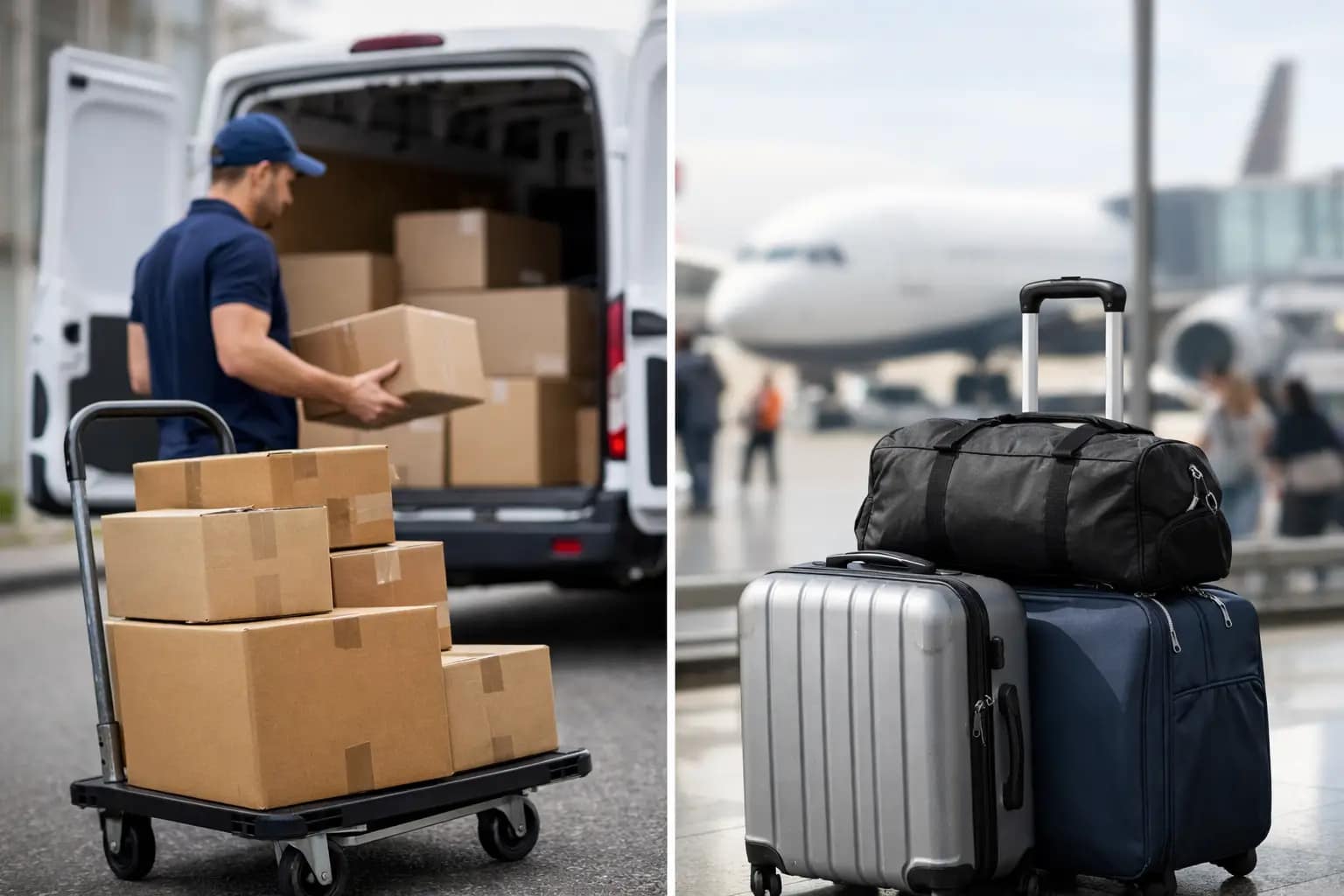
Your suitcase is not an ordinary box when it contains the clothes, equipment, documents, or personal items you need at your next stop. The choice between courier vs luggage transport can determine whether your belongings arrive on time, who handles them, and how easily you can respond if travel plans change.
For a small parcel with a flexible delivery date, a standard courier is often the practical choice. For luggage connected to a hotel stay, airport transfer, ski trip, business appointment, or move between cities, a dedicated transport service can offer more direct coordination. The best option depends on the route, deadline, size of the bags, and the level of support you need.
Courier vs Luggage Transport: The Main Difference
A courier service is designed around shipping parcels through an established delivery network. You prepare the shipment, apply a label, arrange pickup or drop-off, and the item may pass through one or more sorting centers before reaching the destination. This model is efficient for standard packages, especially when the delivery address and timing are straightforward.
Luggage transport is organized around the needs of a traveler and the journey itself. Instead of treating a suitcase like any other shipment, the service can be planned around hotel check-in, a train arrival, an airport departure, or a specific handover point. This is particularly useful when you are moving through unfamiliar places, traveling with several bags, or trying to avoid carrying heavy luggage between accommodations.
The difference is not simply speed. A courier may offer express shipping, while luggage transport may be scheduled in advance. The real distinction is coordination. With luggage transport, the provider can often work from a clear itinerary and a direct point of contact rather than a generic delivery window.
When a Courier Is the Better Option
A courier can make sense when your luggage is packed as a conventional shipment and there is no need to coordinate with your own arrival. For example, you may want to send a suitcase home after a longer stay, ship a forgotten item to a fixed address, or send a non-urgent bag ahead with enough time for possible delays.
Cost can also be a deciding factor. Standard courier services may be less expensive for smaller, well-packed items traveling on common routes. They can be especially useful when the recipient is available at a residential or business address and there is no need for a driver to meet a train, hotel, or flight schedule.
However, travelers should read the service conditions carefully. Couriers may have rules about dimensions, weight, fragile items, valuables, batteries, liquids, and insurance coverage. A suitcase should be labeled clearly and secured properly, but it may still be handled alongside many other shipments during transit.
Tracking is one of the strongest advantages of a courier. Many services provide shipment updates and delivery confirmation through a tracking number. That visibility can be helpful, but it does not always solve a practical problem such as a delayed delivery at a hotel when you need your clothes for an event that evening.
When Luggage Transport Is the Better Choice
Luggage transport is often the more suitable option when bags and passenger travel need to stay connected. Consider a family arriving at an airport with strollers, ski equipment, and multiple suitcases. Or a business traveler who needs to go directly from a station to a meeting without pulling a large case through town. In these situations, reducing physical effort is only part of the benefit. The larger advantage is having a clear plan.
A dedicated service is also valuable for hotel-to-hotel transfers. You can leave your luggage at one accommodation, spend the day sightseeing or attending appointments, and have the bags delivered to the next agreed location. This arrangement can make a multi-stop trip more comfortable, particularly in areas with hills, pedestrian zones, limited parking, or connections that are inconvenient with heavy luggage.
Timing matters most on routes where there is little room for error. If your bags must arrive before a hotel check-in, cruise departure, event, or early morning flight, direct communication with the transport provider is often more reassuring than relying only on a general delivery estimate.
For visitors traveling around Bressanone, the wider South Tyrol area, or onward to destinations in Italy and neighboring countries, Taxi Brixen Bressanone James can arrange luggage delivery alongside private transfer needs. This is useful when an itinerary includes hotels, rail stations, airports, or locations that require a flexible handover.
What to Consider Before You Choose
Start with the delivery deadline. Ask yourself whether your bag needs to arrive by a precise time or simply within a few days. A courier may be appropriate for flexible timing. If the luggage is essential to the next stage of your journey, a scheduled transport service is usually the safer fit.
Next, look at the handover process. Courier deliveries generally require a complete address, a label, and someone who can receive the shipment. Luggage transport may allow more personal arrangements, such as delivery to a hotel reception, collection from an apartment, or a meeting point coordinated with your driver.
Also consider the contents. Do not send passports, cash, medications, essential travel documents, or irreplaceable valuables in checked or transported luggage. Keep those items with you whenever possible. If you are carrying sports gear, musical instruments, fragile objects, or unusually large bags, describe them clearly before booking. The right vehicle, handling process, and price may depend on size and weight.
Finally, think about what happens if your plans change. Flights are delayed, meetings run late, and hotel reservations are occasionally modified. A courier network follows its own route and delivery procedures. A local transport provider may be able to adjust the pickup or handover when informed early enough. That flexibility can be worth more than a lower base price.
Questions to Ask Any Provider
Before sending your bags, confirm the pickup location, final delivery address, expected time frame, and name of the person receiving the luggage. If delivery is going to a hotel, provide the reservation name, arrival date, and any details requested by the reception desk.
It is also sensible to ask how the luggage will be identified, whether you will receive confirmation of delivery, and what coverage applies in the event of loss or damage. For cross-border travel, verify whether any customs requirements apply to the items you are transporting. Personal luggage and commercial shipments can be treated differently, so clear information avoids surprises.
For a direct transport service, ask whether the bags will travel on the planned route, whether the delivery time can be coordinated with your schedule, and how to contact the driver or dispatcher if plans change. A clear answer to these practical questions is a good sign that the service is prepared for the journey.
Pack for Transport, Not Just for Travel
Even when using a professional service, a few simple preparations protect your belongings. Use a durable suitcase that closes securely, remove old airline tags, attach a luggage tag with your name and contact number, and place a copy of your destination details inside the bag. Take photos of the exterior and contents before pickup, especially if you are transporting higher-value items.
Avoid leaving loose straps, as they can catch during handling. If you are sending separate items such as skis, golf bags, or boxed equipment, make sure each piece is clearly marked. A list of the number of bags handed over can prevent confusion when a group is traveling together.
The right choice is the one that fits the importance of the bag, not only the distance it must travel. If the luggage can arrive on a standard schedule, a courier may be enough. If it needs to follow your itinerary and reach a hotel, station, airport, or meeting point with personal coordination, luggage transport gives you a more practical way to travel lighter and stay focused on where you are going.
