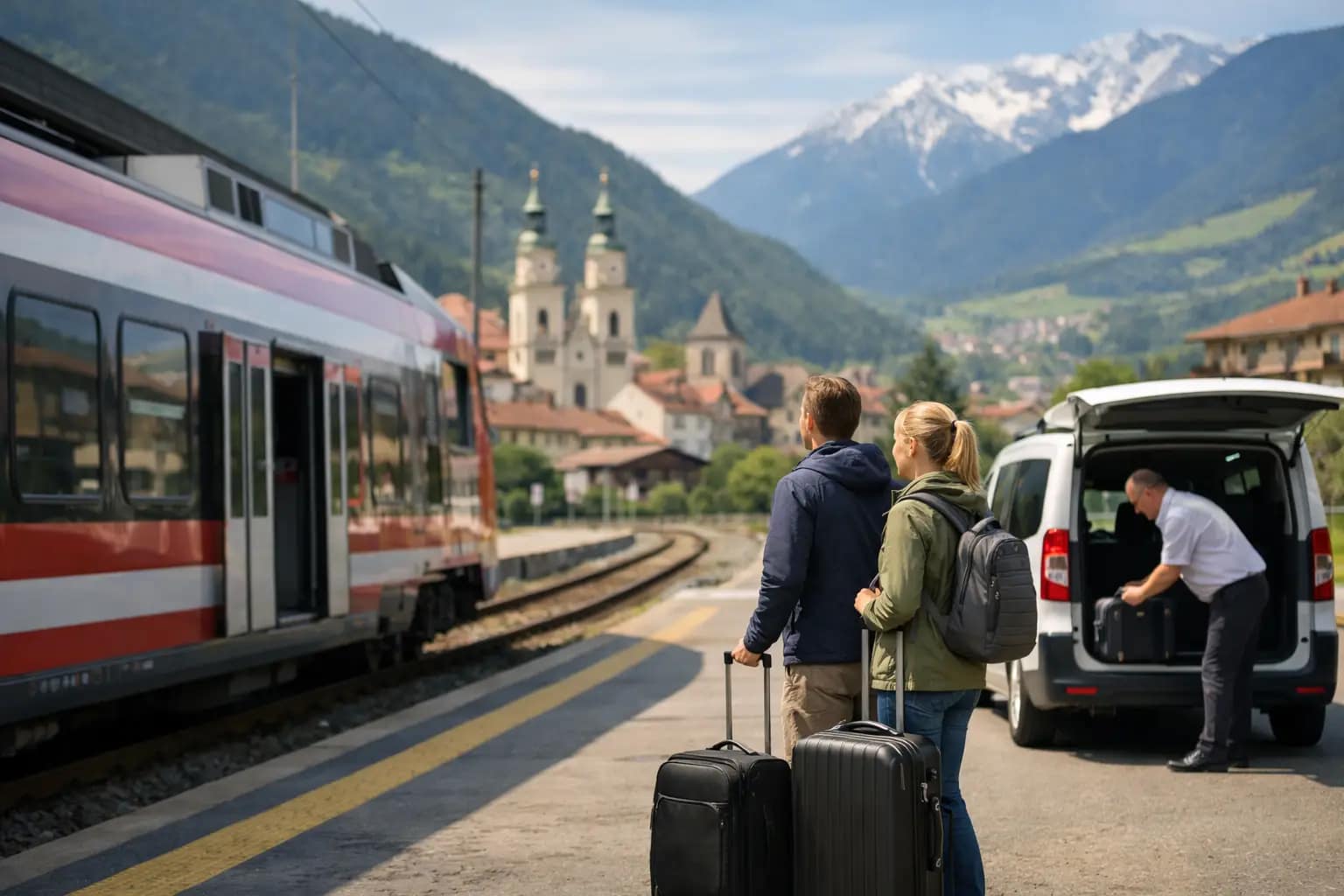
A late train, unfamiliar platforms, heavy luggage, and a hotel outside the town center can turn a simple arrival into a stressful experience. This guide to railway transfers explains how to organize a dependable station pickup or drop-off in Bressanone and throughout Alto Adige, whether you are traveling for a holiday, a business meeting, or a connecting flight.
Guide to Railway Transfers: What to Arrange First
A railway transfer is a pre-arranged ride between a train station and your next destination. It may be a hotel pickup, a trip from your accommodation to the station, or a longer transfer from the station to an airport, ski area, conference venue, or private address.
The main benefit is certainty. Instead of arriving and looking for a cab, checking local bus schedules, or walking with bags in bad weather, you know who will meet you and where you are going next. This is especially useful at Bressanone/Brixen station, where travelers often continue toward mountain hotels, nearby villages, or destinations across Italy and neighboring countries.
When requesting a transfer, provide the train number, arrival or departure time, station name, destination, number of passengers, and approximate luggage. These details allow the driver to plan the right vehicle, calculate travel time, and prepare for possible rail delays.
If you are booking a station drop-off, share the train’s scheduled departure time rather than simply saying when you would like to leave. A professional driver can then recommend a pickup time that considers traffic, the distance to the station, luggage handling, and the time needed to find the correct platform.
Timing Matters More Than Most Travelers Expect
For an arrival transfer, train number is more useful than a scheduled arrival time alone. Trains can be delayed, particularly when a journey includes several connections or crosses national borders. With the train number, your driver has a clear reference point and can coordinate the pickup more accurately.
For departures, allow a reasonable buffer. The right amount depends on your route. A traveler taking a regional train with a small bag may need less time than a family with strollers and suitcases, or a business traveler who must catch a long-distance connection. During winter weather, holiday weekends, and major local events, extra time is a sensible precaution.
It also helps to agree on a meeting point before you travel. Larger stations may have several exits, parking areas, or taxi zones. A clear instruction such as meeting outside the main entrance, near a designated pickup area, prevents unnecessary calls and waiting after a long journey.
What if your train is delayed?
A delay does not have to disrupt the rest of the trip, but communication is essential. Keep your phone charged and switched on after arrival. If you receive an update from the rail operator, notify your transfer provider as soon as possible, particularly if the delay is significant or you miss a connection.
A pre-booked private transfer offers more flexibility than trying to arrange transportation at the last minute. However, flexibility still depends on vehicle availability, driver scheduling, and the extent of the delay. Booking early and providing accurate travel details gives everyone the best chance of adapting quickly.
Choose the Right Transfer for Your Journey
Not every station trip has the same requirements. A couple traveling from Bressanone station to a central hotel may only need a short, direct ride. A group heading to a chalet in the mountains may need room for skis, large luggage, or child seats. An executive arriving for a meeting may value a quiet, punctual transfer that keeps the schedule on track.
Think about the whole itinerary, not just the distance from the station. Consider the location of your hotel, the time of arrival, the number of bags, and whether you have onward travel the same day. A station that looks close on a map may still involve uphill roads, limited public transportation, or an inconvenient walk after dark.
For travelers continuing to an airport, a direct railway-to-airport transfer can be a practical alternative when train connections are limited or when the timetable leaves little room for error. It can also make sense for early-morning departures, late-night arrivals, or journeys with children and substantial baggage.
Taxi James Brixen Bressanone provides private railway transfers for local, national, and international travel, with service tailored to the passenger’s schedule and destination. A direct quote before booking helps clarify the route, pickup timing, and any special requirements.
Luggage, Equipment, and Special Requests
Luggage is one of the most common reasons to arrange a transfer in advance. Tell the provider not only how many people are traveling, but also what they are carrying. Two passengers with two carry-on bags need a different amount of space than two passengers with four large suitcases, a stroller, and sports equipment.
If you are traveling with skis, bicycles, musical instruments, folding wheelchairs, or oversized items, mention this when booking. The same applies to child seats. These requests are usually manageable when known in advance, but they should never be assumed.
Travelers staying in the Dolomites should also consider seasonal conditions. In winter, proper equipment and a driver familiar with local routes can make the final part of the journey much more comfortable. In summer, road traffic around popular destinations can affect timing, even when the train has arrived exactly as scheduled.
How to Book a Railway Transfer Without Gaps
A good booking request is brief but complete. Include your full name, mobile number with country code, date of travel, train number, arrival or departure time, passenger count, luggage details, and final address. If you are being picked up at a hotel, provide the hotel name. If your destination is a private accommodation, share the exact address and any useful access information.
Confirm whether the price includes waiting time, parking, tolls, and luggage. This avoids surprises and is particularly worthwhile for long-distance trips or transfers involving airports. If your plans may change, ask about the procedure for amendments or cancellations before confirming the ride.
International visitors should make sure their phone works in Italy or can connect to Wi-Fi on arrival. Saving the driver’s number and the pickup instructions before the train enters an area with limited signal is a small step that can save time later.
A quick checklist before departure
Before boarding your train, check that you have the correct station name, the driver’s contact information, and the pickup time or meeting point. Keep travel documents and valuables with you rather than placing them in a suitcase. If your train changes platforms or is delayed, send a short message with the update.
For a station drop-off, have your bags ready a few minutes before the agreed pickup time. This keeps the departure calm and gives the driver the best chance of getting you to the station with time to spare.
When a Private Railway Transfer Is the Better Choice
Public transportation is often a good option for straightforward daytime routes with light luggage and flexible schedules. A private transfer becomes more valuable when the journey has less room for uncertainty: a late arrival, an early train, a remote hotel, a tight airport connection, limited mobility, or a group traveling together.
It is also useful when you want one responsible point of contact from pickup to destination. Rather than coordinating several bus routes, waiting in a taxi line, or splitting a group across vehicles, you can travel directly and focus on the reason for your trip.
The best railway transfer is the one you barely have to think about once it is arranged. Share accurate details, allow sensible time, and choose a provider that responds clearly to your needs. Then, when the train doors open in Bressanone, the next part of your journey is already taken care of.
